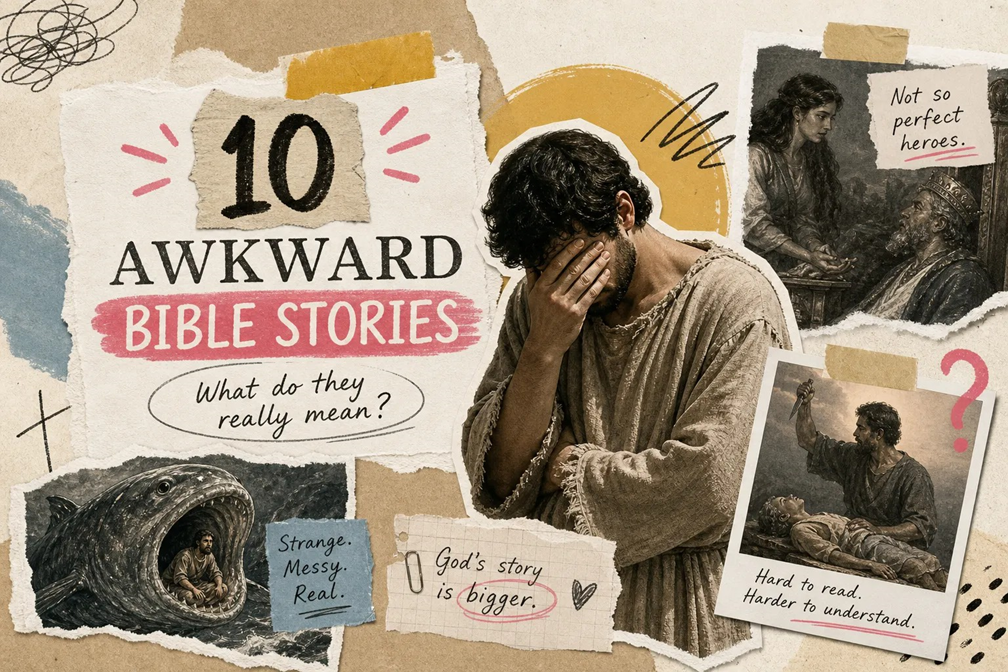
You know that moment. You’re working through a reading plan, maybe with a cup of coffee and good intentions, and you land on a passage that stops you completely. You read it again. Then you quietly close the app, stare at the wall, and wonder if you misread something. You didn’t. The Bible is not a sanitized storybook, and honestly, that’s part of why it can be trusted. A text that only shows humanity at its best would tell us very little about why we need grace.
What follows is a walk through the 10 most awkward Bible stories no one talks about, complete with scripture references, honest historical context, and a short devotional thread for each one. These are the awkward Bible stories your reading plan probably didn’t warn you about, the obscure Bible passages, the controversial chapters, the Bible stories you never hear in church. If Christian Prayer Daily is already part of your reading rhythm, consider this a companion piece for exactly those moments.
When Genesis gets uncomfortably honest
Genesis is often treated as Sunday school territory: creation, Noah, Joseph’s coat. But it also contains some of the most morally complex narratives in all of Scripture, stories involving family, deception, and sexual ethics that stop modern readers cold. These stories were preserved on purpose. Their discomfort is part of the message.
1. Lot’s daughters: survival, desperation, and Genesis 19:30–38
After the destruction of Sodom, Lot and his daughters retreat to a cave in the mountains. Believing civilization has been wiped out and their family line with it, the daughters make a desperate decision: they get their father drunk on consecutive nights and conceive children by him. The sons born, Moab and Ben-ammi, become ancestors of Israel’s neighbors, the Moabites and Ammonites.
In the ancient Near East, continuing a family line was a survival imperative, not merely a preference. In that world, a woman without a husband or children lost protection, status, and economic security. The daughters may have believed, or convinced themselves, that no suitable men remained anywhere.
Scripture does not endorse what happened here. It records it honestly, including the trauma, the isolation, and the distorted judgment that catastrophe can produce. If you’ve ever encountered a passage that left you morally disoriented, bring that confusion directly to God in prayer. Honest wrestling with a hard text is itself a form of faithfulness.
2. Judah and Tamar: justice in an unlikely disguise (Genesis 38)
Tamar was a widow twice over, and both times her father-in-law Judah withheld his third son from her as a husband. Under levirate law, outlined in Deuteronomy 25:5–10, this was a binding social and legal obligation in ancient Israel, not merely a preference or a custom. Desperate for justice and for the family standing she was legally owed, Tamar disguised herself as a prostitute, slept with Judah, and later produced his signet and staff as proof of his own hypocrisy.
Judah’s response is striking: “She is more righteous than I.” And here is where the story gets redemptive in the most unexpected way. Tamar’s son Perez is listed directly in the genealogy of Jesus in Matthew 1:3.
God’s thread of redemption runs through even this, through deception, injustice, and the persistence of a woman who refused to be erased.
3. Dinah and the city of Shechem: Genesis 34 and the cost of silence
Dinah, Jacob’s daughter, is violated by Shechem, a local ruler’s son who then wants to marry her. Her brothers Simeon and Levi respond not with a legal process but with a massacre, tricking the men of the city into circumcision and killing them while they were recovering. The scale of the retaliation is disturbing, and Dinah herself, though she is the central figure, never once speaks in the entire chapter (Genesis 34).
Honor-based tribal justice shaped this ancient world in ways that differ radically from modern ethics. But the text doesn’t ask us to celebrate the massacre. It asks us to sit with it. To notice who is harmed, who is silenced, and who is centered in the aftermath. Passages like this invite lament, not easy answers, and they remind us that the Bible takes the dignity of victims seriously even when the people in the story do not.
The book of Judges: awkward Bible stories the chapters no one reads at Bible study
Judges describes a cycle of moral collapse in Israel, a downward spiral summarized by its haunting final verse: “Everyone did as they saw fit” (Judges 21:25). Three of the strangest, most rarely discussed Bible stories in all of Scripture live here. Judges is not a hero manual. It’s a mirror.
4. Jephthah’s terrible vow and his daughter (Judges 11:29–40)
Before battle, Jephthah makes a rash vow: if God gives him victory, he will sacrifice whatever first comes out of his house to greet him. His daughter comes running out to celebrate. Interpreters debate whether Jephthah actually killed her or dedicated her to lifelong service at the sanctuary, but both readings share the same central tragedy: a reckless attempt to bargain with God caused an innocent person to suffer.
Vows carried enormous social and religious weight in ancient Israel, which is exactly what makes the story so devastating.
Jephthah’s conduct fits the larger pattern of Judges, where Israel’s leaders increasingly imitate the nations around them rather than the covenant they were given. If you are grieving something senseless, or wrestling with a vow made in desperation, this passage is one of Scripture’s most honest companions in that pain.
5. Ehud’s graphic assassination of King Eglon (Judges 3:12–30)
Ehud, a left-handed man, conceals a double-edged sword on his right thigh and requests a private meeting with Eglon, the Moabite king who had oppressed Israel for eighteen years. What follows is described with a level of physical specificity that makes most readers uncomfortable. The graphic detail almost certainly served a literary purpose for its ancient audience: Moabite oppression is being undone, and the story uses darkly comic imagery to make that point.
God uses unexpected people, unexpected methods, and unexpected moments. Ehud’s left-handedness, which would have been considered a disadvantage, is exactly what made the plan work. That theme of God choosing the unlikely runs all the way through Scripture, and Judges 3 is one of its most surprising examples.
6. The Levite’s concubine: one of the most harrowing stories in Scripture (Judges 19–20)
This is one of the hardest passages in the entire Bible, and it deserves to be handled with care. A woman
is violently abused and killed by men in the city of Gibeah. Her husband, a Levite, dismembers her body and sends the pieces to the twelve tribes of Israel to summon them to war. The tribal response cascades into civil war and further atrocity.
Its placement at the end of Judges is deliberate. Israel, formed to be distinct through covenant law, has become indistinguishable from the surrounding world: violence, exploitation, collective retaliation, and moral fragmentation have swallowed it whole. The woman at the center of this story is never named. She does not speak. Her suffering drives the narrative, and the text asks us to feel the weight of that. A passage like this calls the church to name harm plainly, to refuse to look away, and to pray for survivors with the same honesty that Scripture itself brings.
Prophets and kings doing things that raise real questions
The prophetic era and the monarchy are full of weird Bible narratives that disrupt a tidy picture of how God, justice, and human leadership interact. Three of these lesser-known Bible stories are worth examining closely.
7. Saul and the medium at Endor: 1 Samuel 28
The night before his final battle, Israel’s first king does something he knows is forbidden: he visits a medium in secret and asks her to summon the deceased prophet Samuel. Samuel appears, delivers a message of judgment, and confirms that Saul and his sons will die the following day. Consulting the dead was strictly prohibited under Mosaic law, which is exactly what makes Saul’s desperation so stark. He had already driven mediums out of Israel. Now he was one of their customers.
Saul’s story is a slow tragedy of a man who kept looking for God’s guidance everywhere except through the means God had provided. His visit to Endor is the final scene in that pattern. If you find yourself looking for direction in all the wrong places, Saul’s story is a sobering and compassionate reminder that surrender is always the better posture than control.
8. Elisha and the two bears: 2 Kings 2:23–25
Elisha is traveling toward Bethel when a group mocks him, calling out “Go up, baldhead!” Two bears emerge from the woods and maul forty-two of them. It genuinely baffles most modern readers, and understandably so. But the Hebrew term translated “young men” can refer to adolescents or young adult males, and the group may have been a large, threatening mob rather than a cluster of children making schoolyard jokes.
The Hebrew insult “baldhead” likely targeted Elisha’s prophetic authority, challenging whether he was truly Elijah’s successor. Elisha pronounced a curse in the name of the Lord; the text does not say he summoned bears himself. The judgment, on this reading, was God’s vindication of prophetic authority in a spiritually
corrupt region. The seriousness of despising God’s messengers runs through this story as a sobering undercurrent, even if its severity remains jarring to modern sensibilities.
9. Ezekiel’s graphic allegory: Ezekiel 23
Ezekiel 23 uses deliberately explicit imagery to depict Samaria and Jerusalem as two sisters who have been repeatedly unfaithful. The language is intentionally shocking, and it was meant to be. Theologians classify this as a prophetic allegory, a recognized literary form in the ancient Near East where cities and nations were personified as women, with political alliances and idolatry portrayed as sexual betrayal.
The graphic imagery is not the point; it’s the vehicle. “Adultery” and “prostitution” in this chapter represent Israel’s idolatry and its trust in foreign powers rather than in God. The shock value was intentional: the nations had not made isolated mistakes but had repeatedly and shamelessly violated their covenant relationship with God. Scripture takes spiritual unfaithfulness that seriously.
When justice looks nothing like we expected: Daniel 6:24
Daniel 6 is one of the Bible’s most beloved chapters: the faithful man, the lions’ den, the miraculous deliverance. But the chapter has a quietly disturbing coda that sermons rarely reach.
10. Daniel’s accusers and their families: the lions’ den aftermath
After Daniel’s miraculous survival, King Darius has Daniel’s accusers thrown to the lions, along with their wives and children. Collective punishment, the extension of judgment to an entire family unit, was standard practice in ancient Persian justice. It was not an unusual cruelty invented for this story; it was how ancient Near Eastern legal systems understood accountability and deterrence.
That context doesn’t make it comfortable reading. But it highlights a distinction Scripture consistently draws: the difference between God’s redemptive justice and human retribution. Daniel’s survival was an act of divine mercy. The fate of his accusers was an act of Persian law. The text records both without conflating them, and that’s an important interpretive move. God is not the author of every outcome described in Scripture.
Why these awkward Bible stories still matter today
Across all ten stories, a single interpretive principle applies: Scripture describes. It does not always prescribe. Description is not endorsement. The Bible records what human beings did, what ancient cultures valued, and how deeply broken the world has always been, not as a manual for behavior but as an honest witness to the human condition and our need for redemption. Understanding ancient cultural norms is not relativism. It’s intellectual honesty, and it makes you a better reader of the whole Bible.
How to keep reading when a passage shakes you
These stories don’t have to be conversation-stoppers. They can be doorways into a richer, more honest faith, if you know how to approach them.
Bringing the uncomfortable passages into your prayer life
Prayer is not just for the easy scriptures. The Psalms model exactly this: bringing confusion, grief, and moral disorientation directly to God in honest language. When a hard passage unsettles you, don’t skip it. Sit with it. Ask God what it reveals about the world, about human nature, and about why grace matters as much as it does. Christian Prayer Daily offers prayers, devotionals, and seasonal encouragement.
Using historical context as a compassionate lens
Before reacting to a strange or disturbing story, ask what world the characters lived in. What did family, honor, justice, and survival mean to them? Historical and cultural context doesn’t excuse everything, but it explains a great deal, and it keeps you from reading ancient texts through a modern lens that wasn’t there when they were written. Christian Prayer Daily provides Bible study tools and thematic devotionals.
Why the 10 most awkward Bible stories no one talks about belong in your faith journey
Sitting with these passages is not a threat to your faith. It’s an act of it. A faith that can only survive sanitized Bible stories isn’t ready for the full weight of what Scripture actually offers: a ruthlessly honest account of human darkness and a God who enters it anyway. That contrast is exactly what makes the gospel so staggering.
These controversial Bible stories are worth bringing into small group settings, where discussion can happen safely, curiosity can be welcomed, and no one has to wrestle alone. They’re worth praying over, sitting with, and returning to. The discomfort is not a sign that something has gone wrong. It’s a sign that you’re reading closely enough to hear what the text is actually saying.
For anyone who wants a daily companion through Scripture, including its harder corners, Christian Prayer Daily offers prayers, devotionals, and Bible study resources for the full journey. The 10 most awkward Bible stories no one talks about are not problems to solve. They’re invitations to go deeper. The Bible’s complexity is not a barrier to faith. It’s one of the surest signs that what you’re reading is real.