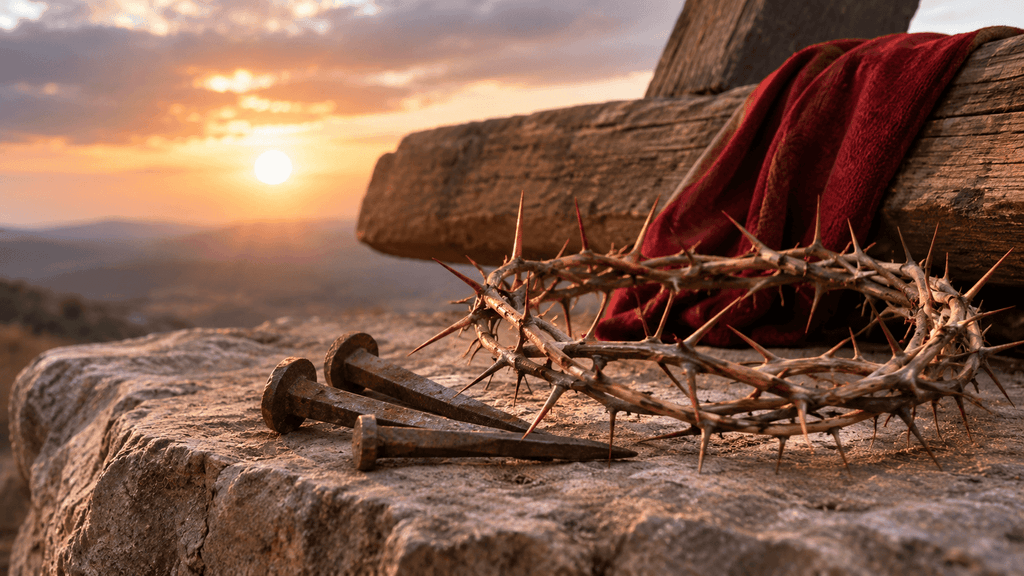
A cross can be seen in almost every Christian setting. It hangs above church altars, appears in paintings, rests beside family photographs, and is worn as a small pendant. Because it is so familiar, it is possible to recognize the symbol without spending much time thinking about the event behind it.
For Christians, that event is the crucifixion of Jesus Christ.
The story begins with an arrest in Jerusalem and ends with Jesus’ death at a place called Golgotha. Between those moments are scenes of betrayal, political pressure, humiliation, suffering, and words that Christians continue to read and remember. Yet the meaning of the cross extends beyond the events of one afternoon. It raises some of the central questions of Christian faith: Why did Jesus die? What did His sacrifice accomplish? And what difference should it make to the way a person lives?
To understand Jesus and the cross, it helps to look at the Gospel accounts first, then consider the historical setting and the spiritual meaning Christians find in His death.
The Journey of Jesus to the Cross
The four Gospels describe the final hours of Jesus’ life, although each writer selects and emphasizes different details.
After the Last Supper, Jesus went with His disciples to Gethsemane. There, He prayed while knowing that His arrest was approaching. Judas Iscariot arrived with those who had come to seize Him, identifying Jesus to them.
Jesus was taken before the Jewish authorities and later brought to Pontius Pilate, the Roman governor. Although Pilate questioned Him, he eventually handed Jesus over to be crucified.
The soldiers mocked Him, placed a crown of thorns on His head, and led Him away. The Gospel accounts describe the journey to the place of execution, where Jesus was crucified between two criminals.
The events are recorded in Matthew 26–27, Mark 14–15, Luke 22–23, and John 18–19. Reading these chapters together gives a fuller picture of the final hours, while also allowing each Gospel’s particular details to remain distinct.
Who Carried the Cross of Jesus?
There is an interesting difference in the Gospel accounts concerning the journey to Golgotha.
John 19:17 says that Jesus went out carrying His own cross. Matthew 27:32, Mark 15:21, and Luke 23:26 mention Simon of Cyrene, who was compelled to carry it.
Simon was passing by when the soldiers forced him to help. Mark identifies him as the father of Alexander and Rufus, suggesting that these names would have meant something to the Gospel’s original audience.
Readers sometimes reconcile the accounts by suggesting that Jesus began carrying the cross and Simon took over along the way. That is a possible explanation, but the Gospel writers do not give a detailed account of exactly how the transfer happened.
What remains clear is that Simon became part of the journey to the crucifixion, despite not choosing to be there.
His appearance also brings to mind Jesus’ earlier teaching in Matthew 16:24: disciples must deny themselves, take up their cross, and follow Him. In the Gospel narrative, Simon physically carries the cross; in Jesus’ teaching, taking up one’s cross describes the cost of following Him.
What Does Golgotha Mean?
The Gospel writers call the place of Jesus’ execution Golgotha, a name traditionally translated as “place of the skull.” The Latin name Calvary comes from a word with the same meaning.
The exact location has been debated for centuries. The Church of the Holy Sepulchre in Jerusalem is the principal traditional site associated with Jesus’ crucifixion and burial. Another proposed location, often called Gordon’s Calvary, became well known in the nineteenth century because of the appearance of the nearby rock formation.
The available evidence does not establish the precise spot beyond doubt. The Church of the Holy Sepulchre, however, has a long historical association with the location and remains central to Christian pilgrimage.
The important point for understanding the Gospel story is that Jesus was executed in the Jerusalem area under Roman authority. Golgotha was not merely a theological idea; the Gospel writers present it as a real place connected with a real execution.
How the Four Gospels Describe the Crucifixion
The four accounts should not be treated as four identical retellings. Each Gospel gives readers details that help shape its presentation of Jesus.
Matthew — Matthew 27
Matthew describes the soldiers mocking Jesus, the division of His garments, the darkness, and the reaction of those watching. He records Jesus’ cry, “My God, My God, why have You forsaken Me?” The account also describes the tearing of the temple curtain and other extraordinary events following His death.
Mark — Mark 15
Mark gives a direct account of Jesus’ suffering and death. He records the mockery, the darkness, Jesus’ cry to God, and the centurion’s response after witnessing how He died.
Luke — Luke 23
Luke includes Jesus’ prayer for those responsible for His crucifixion, His words to the criminal beside Him, and His final prayer committing His spirit to the Father. These details place particular emphasis on mercy, hope, and trust.
John — John 19
John records Jesus speaking to His mother and the beloved disciple, saying “I thirst,” and declaring “It is finished.” The account also describes the soldier piercing Jesus’ side.
Reading the accounts side by side is useful, but it is important not to force every detail into an explanation that the text itself does not provide.
The Seven Last Words of Jesus on the Cross
Christians have traditionally brought together seven sayings from the four Gospels and reflected on them as the Seven Last Words of Jesus.
No single Gospel contains all seven. The familiar sequence is a devotional arrangement assembled from the different accounts.
The sayings are:
- “Father, forgive them, for they know not what they do.” — Luke 23:34
- “Today you will be with Me in Paradise.” — Luke 23:43
- “Woman, behold your son.” — John 19:26–27
- “My God, My God, why have You forsaken Me?” — Matthew 27:46; Mark 15:34
- “I thirst.” — John 19:28
- “It is finished.” — John 19:30
- “Father, into Your hands I commit My spirit.” — Luke 23:46
These words are remembered because they give readers different ways to reflect on Jesus’ final hours: His concern for others, His experience of suffering, His relationship with the Father, and the completion of His mission.
They are particularly prominent in Good Friday worship and devotional reading.
For a closer examination of each saying, its biblical context, and a prayer for reflection, read our guide to the [Seven Last Words of Jesus on the Cross].
Why Did Jesus Die on the Cross?
This question goes to the heart of Christianity. The crucifixion was an execution in its historical setting, but Christians understand Jesus’ death as much more than the end of His earthly life.
The New Testament connects His death with humanity’s need for forgiveness and reconciliation with God. It also connects the cross with victory over sin and death, and with the love that God has shown through His Son.
These themes are related, but they are not always explained in exactly the same way by every Christian tradition.
The Cross and God’s Love
Romans 5:8 expresses a central Christian conviction: Christ died for humanity while people were still sinners.
The significance of this is easy to overlook. The message is not that people first made themselves acceptable to God and then received His love. Rather, God’s grace is shown in the sacrifice of Jesus.
The cross therefore speaks to people who know their own failures and limitations. Christian faith does not ask them to pretend they have never done wrong. It points them toward the forgiveness and new life offered through Christ.
The Cross and Forgiveness
Ephesians 1:7 connects redemption with Christ and the forgiveness of sins.
In Christian teaching, forgiveness is not simply a matter of forgetting wrongdoing. It is part of God’s work of restoring the relationship between Himself and humanity.
The cross is central to this belief because Jesus’ sacrifice is understood as the means through which reconciliation becomes possible.
This also has consequences for everyday life. Those who receive forgiveness are called to consider how they treat other people, including those who have disappointed or hurt them.
The Cross and Victory Over Death
The crucifixion cannot be separated from the resurrection in the Christian message.
If the story ended with Jesus’ death, the central Christian proclamation would be incomplete. The resurrection is presented in the New Testament as God’s victory over death and the foundation of Christian hope.
Colossians 2:13–15 describes Christ’s triumph over the powers and authorities. First Corinthians 15:54–57 celebrates the defeat of death through Jesus Christ.
This is why Christians move from the sorrow of Good Friday to the celebration of Easter. The cross is remembered alongside the resurrection, not in isolation from it.
The Cross and the Cost of Following Jesus
Jesus also spoke about the cross in relation to the lives of His followers.
In Matthew 16:24, He told His disciples to deny themselves, take up their cross, and follow Him.
For a Christian, this is a call to more than wearing a cross or speaking about faith. It involves a willingness to put Christ’s teaching into practice, even when doing so requires sacrifice.
It may mean choosing honesty when dishonesty would be easier, forgiving rather than nurturing revenge, serving without expecting recognition, or remaining faithful when circumstances become difficult.
The cross points to what Christians believe Jesus accomplished, but it also challenges them to examine the direction of their own lives.
What Historical Evidence Tells Us About Crucifixion
Jesus’ crucifixion took place during the period of Roman rule in Judea. Crucifixion was a Roman form of execution used in the ancient world, particularly as a public punishment intended to humiliate and deter.
Archaeology has provided evidence that crucifixion by nailing was practised in the region during this period.
In 1968, excavations at Giv’at ha-Mivtar, near Jerusalem, uncovered the remains of a man commonly identified as Yehohanan. An iron nail was found embedded in his heel bone. The discovery is important because it provides physical evidence of how crucifixion could be carried out in Roman-era Judea.
It is important to be precise about what this discovery establishes. These were not the remains of Jesus. They belong to another individual and provide evidence of the execution practice, not direct archaeological proof of the details of Jesus’ death.
The historical setting helps readers understand the severity of the punishment described in the Gospels. Crucifixion was designed to expose the condemned person to public shame and physical suffering.
For Christians, this historical reality gives added weight to the belief that Jesus willingly endured the cross.
Three Ways Christian Theology Explains the Cross
Over the centuries, Christian thinkers have explored how Jesus’ death brings salvation. Three well-known approaches are often discussed: penal substitution, Christus Victor, and moral influence.
They emphasize different aspects of the cross and should not be treated as three identical explanations.
Penal Substitution: Christ Bore the Penalty of Sin
Penal substitution focuses on the relationship between sin, justice, and forgiveness.
In this understanding, humanity is accountable for sin, and Jesus takes the place of sinners by bearing its penalty. Through His sacrifice, forgiveness and reconciliation with God become possible.
Isaiah 53:4–6, Romans 5:8–9, and 1 Peter 2:24 are among the passages commonly discussed in connection with this view.
Christus Victor: Christ Overcame the Powers of Evil
The Latin expression Christus Victor means “Christ the Victor.”
This approach emphasizes that Jesus’ death and resurrection bring victory over sin, death, and the powers of evil. The cross is not understood simply as a moment of suffering; it is part of God’s victory and the liberation of humanity.
Colossians 2:15 and 1 Corinthians 15:54–57 are important passages for exploring this theme.
Moral Influence: The Cross Changes the Human Heart
The moral influence understanding focuses on the love revealed through Jesus’ sacrifice.
Seeing what Christ has done encourages people to respond with faith, gratitude, repentance, and love. The cross becomes a powerful example of self-giving love that should influence how believers treat others.
This perspective draws attention to the personal and ethical consequences of the crucifixion.
These approaches highlight different dimensions of Christian teaching. Traditions differ in how they explain their relationship, but together they help readers explore why the cross holds such a central place in Christian theology.
How Christians Reflect on the Cross Today
The cross is important to Catholic, Orthodox, and Protestant Christians, although the way it is expressed in worship and theology varies.
In Catholic practice, Good Friday includes the celebration of the Passion of the Lord and the veneration of the cross. The crucifixion is understood within the wider Paschal Mystery, which includes Christ’s suffering, death, and resurrection.
Eastern Orthodox worship places strong emphasis on the victory of Christ over death. The cross is closely connected with the resurrection and the belief that Christ entered death to overcome it.
Protestant traditions vary considerably in worship style and theological emphasis. Many services focus on the biblical Passion narratives, the meaning of Christ’s sacrifice, forgiveness, and the call to live by faith.
These differences matter, and it is better not to pretend that every church explains the cross in precisely the same way. Nevertheless, the death and resurrection of Jesus remain central to Christian belief across these traditions.
Bible Verses to Help You Understand Jesus and the Cross
If you want to spend more time studying the meaning of the cross, these passages offer a useful starting point.
Isaiah 53:4–5 — Read this passage to consider the suffering servant and the language of suffering, peace, and healing.
John 3:16 — Reflect on the connection between God’s love, the giving of His Son, and the promise of eternal life.
Romans 5:8 — Consider what it means that Christ died for sinners rather than waiting for humanity to become perfect.
Galatians 2:20 — Explore how faith in Christ changes the believer’s understanding of identity and daily life.
Colossians 2:13–15 — Read about forgiveness and the victory associated with the cross.
1 Peter 2:24 — Reflect on the connection between Christ bearing sins and the call to live in righteousness.
1 Corinthians 15:54–57 — Consider the Christian hope of victory over death through Jesus Christ.
Try reading one passage at a time instead of rushing through the entire list. Ask what it says about Jesus, what it reveals about God’s character, and what response it invites from you.
A Prayer of Reflection on Jesus and the Cross
Heavenly Father,
As I reflect on the cross of Jesus, help me understand the depth of Your love and the meaning of His sacrifice.
Thank You for the forgiveness and hope that Christians find through Christ. When I carry guilt from my past, remind me of Your grace. When I struggle to forgive someone, teach me to respond with wisdom and mercy. When life feels uncertain, help me place my trust in You.
Do not let the cross become something I recognize only as a symbol. Let its message influence my decisions, my relationships, and the way I treat the people around me.
Give me a humble heart, a stronger faith, and the courage to follow Jesus even when the path is difficult.
In Jesus’ name, Amen.
What Does the Cross Mean for Your Life Today?
It is possible to know the story of the crucifixion without allowing its message to influence everyday choices. The challenge is to move from reading about the cross to considering what its meaning asks of us.
Start with something practical.
If the cross reminds you of forgiveness, consider whether resentment has been taking up too much space in your life. If it reminds you of sacrifice, look for an opportunity to help someone without expecting anything in return. If it reminds you of hope, bring a worry or fear into prayer instead of allowing it to shape every decision.
You could also set aside a few minutes each day to read one of the Gospel accounts of the crucifixion. Write down one detail that stands out and one question you would like to explore further.
Faith does not grow through information alone. It also grows through reflection, prayer, and the choices we make when we put what we believe into practice.
The Cross and the Hope of Easter
The story of Jesus and the cross is not only a story of suffering. It is part of the larger Christian message of redemption and resurrection.
At Golgotha, Jesus was crucified under Roman authority. The Gospel writers preserved the events of His final hours, including the words He spoke and the reactions of those who witnessed His death. Christians have returned to these accounts for generations because they find in them the foundations of forgiveness, reconciliation, and hope.
But the story does not end at the cross. The resurrection of Jesus is central to the Christian faith and gives meaning to the celebration of Easter.
The next time you see a cross, take a moment to think beyond its shape. Remember the Gospel accounts, consider the sacrifice they describe, and reflect on what following Jesus means in your own life.