
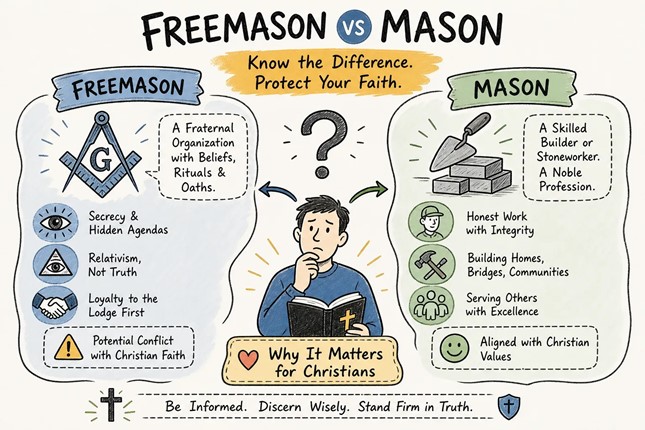
When someone mentions a “mason,” your brain probably pictures a craftsman cutting stone on a job site. When someone mentions a “Freemason,” that same brain probably jumps to secret handshakes and lodge ceremonies. The Freemason and mason distinction genuinely confuses people, and for good reason: the two terms share a history and vocabulary, even though they describe very different things. This article lays out the difference clearly, traces how a craft trade became a philosophical fraternity, and then addresses the honest questions Christians ask about Freemasonry and faith. For readers navigating questions that touch both culture and conviction, Scripture and prayer, rightly applied, are the tools that turn confusion into clarity. That’s exactly what Christian Prayer Daily is built to provide.
Freemason and Mason: What the Terms Actually Mean
The stonemason: a craftsman who builds with stone
An occupational stonemason is a skilled tradesperson who cuts, shapes, sets, and finishes stone for buildings, monuments, interiors, and heritage structures. The word “mason” traces through Anglo-Norman French and Medieval Latin to terms meaning a wall-builder or stone-cutter. It has always referred to
someone doing physical work with physical material.
Today’s stonemason reads architectural drawings, selects appropriate stone (granite, limestone, marble, sandstone), and uses chisels, grinders, saws, and hammers to achieve precise cuts and finishes before setting the stone with mortar. The work demands technical training, physical stamina, geometric precision, and close coordination with architects and contractors. There is no fraternal dimension implied anywhere in that description.
How “Freemason” got its distinct meaning
The term “Freemason” began as a higher-grade trade designation, not a fraternal title. The most well-supported explanation is that it derived from “freestone mason,” a mason skilled enough to carve fine-grained freestone for ornamental architectural detail. Over time, “freestone mason” shortened to “free mason” and then “Freemason.” The first secure English use appears in 1376, where it distinguished a specialized mason from a rough mason. Building records at Eton College in the 1440s use the term alongside “mason” and “master mason” as distinct grades.
Only in the 17th and 18th centuries did “Freemason” solidify as a fraternal title. The formation of the Grand Lodge of England in 1717 is the conventional landmark for organized speculative Freemasonry as a distinct institution. Before that, it was a building trade term. After that, it meant something fundamentally different.
Why the confusion is not accidental
Freemasonry deliberately borrowed and preserved the language of the stoneworking trade. That’s by design, not coincidence. The fraternity built its identity around the symbolism of the craft: the square, the level, the compass, the rough and finished stone. So when someone encounters “mason” and “Freemason” in the same week, the overlap feels intentional because it is.
An occupational stonemason builds structures with stone; a Masonic lodge member uses the symbolism of stonemasonry to build character. Same words, entirely different activities. Understanding that intentional borrowing is the first step to making sense of the Freemason and mason relationship.
From Guild Halls to Grand Lodges: Freemason and Mason History
Medieval stonemason guilds were practical organizations. They controlled apprenticeships, set trade standards, managed mutual support among craftsmen, and oversaw real construction projects, including the great cathedrals and civic buildings of Europe. Geometry and craft knowledge were passed carefully through controlled channels within these operative lodges. Membership meant you actually cut and set stone for a living.
The shift began when non-craftsmen, specifically gentlemen and patrons with no trade background, started being admitted into operative lodges from the late 16th century onward. These “accepted” members had no practical stoneworking role. Instead, they reinterpreted the tools and vocabulary of the craft as moral and philosophical allegory. The square became a symbol of upright conduct. The level became a reminder of equal standing before God. This was the birth of speculative masonry: using the craft’s language to discuss ethics, personal improvement, and philosophy rather than to build anything.
The 1717 Grand Lodge of England formalized this transformation. From that point, Freemasonry was a distinct institution rather than an adjunct of a craftsmen’s guild. One important historical note: modern Freemasonry did not descend from medieval guilds in an unbroken institutional chain. It adopted their language and imagery. The continuity is symbolic and metaphorical, not organizational. Historians generally treat the connection as an inspiration rather than a lineage.
How a Masonic Lodge Actually Operates Today
Craft Masonry centers on three degrees: Entered Apprentice, Fellowcraft, and Master Mason. Each involves a formal ceremony using allegory, symbolic tools, and dramatic presentation designed to communicate ethical teachings. The Entered Apprentice degree focuses on moral formation and self-discipline; the Fellowcraft emphasizes education and intellectual growth; the Master Mason degree addresses fidelity, responsibility, and mortality. These degrees mark stages of personal commitment, not levels of secret political power.
Standard membership requirements in regular Anglo-American grand lodges include being an adult male, holding a belief in a Supreme Being (no specific religion is required), having good moral character, and applying voluntarily. Gender rules and specific religious requirements vary by grand lodge and Masonic body, so these standards are not universal across every Masonic tradition. Freemasonry describes itself as a fraternal organization, not a religion, and members are expected to maintain their own religious practice alongside lodge involvement.
The most persistent myths about Freemasonry are worth addressing directly. The Bavarian Illuminati was a distinct 18th-century organization, founded in 1776 and suppressed by the 1780s. It was not Freemasonry, and no credible evidence shows it survives today. The all-seeing eye on the U.S. dollar belongs to the Great Seal of the United States, not to Freemasonry. Some prominent founders were Masons, including George Washington, but historical records show eight of the 56 Declaration signers were Masons, not most or all of them. Treating symbolic resemblance as proof of conspiracy is a weak form of argument that doesn’t hold up against the documentary record.
Freemason and Mason: What Christians Should Know
The honest starting point is acknowledging where Christian values and Masonic ideals genuinely overlap. Freemasonry emphasizes charity, brotherly love, integrity, service, and humility. Many Christians have
been lodge members and seen no conflict between their faith and fraternal involvement. Dismissing this overlap dishonestly weakens any serious theological conversation about it.
The core tension, though, is real. Masonry requires only belief in “a Supreme Being,” not in Jesus Christ specifically. In a Masonic lodge setting, the Bible may sit alongside the Quran or other sacred texts, treated as equivalent sources of moral truth. For Christians who hold that Jesus is the unique path to God, as stated in John 14:6, this is a substantial doctrinal difference, not a minor one. The initiation oath issue is also significant: Masonic membership involves solemn oaths that some Christians find incompatible with Jesus’ teaching in Matthew 5:33-37 and James 5:12 about letting your yes be yes. Some theologians also argue that Masonic ritual obligations can create a secondary loyalty that competes with the Christian’s primary commitment to Christ and his church (Matthew 6:24).
Major Christian bodies have reached formal conclusions on this question. The Catholic Church has prohibited Catholics from joining Freemasonry since 1738, reaffirming that position as recently as 1983. The Southern Baptist Convention commissioned a study in 1993 that concluded many Masonic teachings are incompatible with Christianity, while leaving membership to individual conscience. Protestant denominations vary more widely: some treat Masonic involvement as a matter of personal conviction, while others advise against it. The Episcopal Church and the Church of England, for instance, have issued cautionary statements while stopping short of prohibition. These denominational positions are worth knowing, but they are not a substitute for your own prayerful discernment guided by Scripture.
Practical Guidance for Christians Navigating Masonic Relationships
If a family member or close friend is a Mason, the right posture is curiosity before confrontation. Ask questions. Understand what the Masonic lodge means to them before explaining your concerns. Many members joined for community, charitable work, and friendship, and acknowledging that sincerely keeps conversation open rather than closing it down. Approaching a loved one with alarm produces walls; approaching them with genuine interest produces dialogue.
Several scripture passages are especially useful for personal discernment in this situation. Joshua 24:15 frames the question of whom you will ultimately serve. Second Corinthians 6:14 addresses being unequally yoked in associations. Proverbs 3:5-6 anchors the decision in trusting God for wisdom rather than demanding instant certainty. These passages work best not as debate ammunition but as personal prayer anchors. Christian Prayer Daily’s topical Bible verse library organizes Scripture by theme, including wisdom, discernment, and family, making it straightforward to locate the exact passages you need for quiet reflection or a real conversation.
Two prayer intentions worth bringing before God can steady you before and during these conversations. Before engaging a loved one, pray for an open heart, honest words, and the grace to love the person regardless of where the conversation leads. Before making any personal decision about Masonic
involvement, pray for clarity, patience, and wisdom rather than pressure and anxiety. Christian Prayer Daily offers a full range of discernment and family prayers organized by life situation, available as printable resources for personal quiet time or small-group settings.
Conclusion
To summarize the difference plainly: “mason” is an occupational title for a skilled craftsman who works with stone; “Freemason” refers to membership in a fraternal organization that adopted and transformed that craft’s symbolism over several centuries. One is a trade; the other is a philosophical brotherhood that borrowed the trade’s language to talk about something else entirely. The Freemason and mason distinction matters because conflating them leads to real confusion, both about a legitimate profession and about the nature of a fraternal organization with genuine theological implications for Christians.
For Christians, the question is not whether Freemasonry has good values. It does, in places. The question is whether its framework for faith and allegiance aligns with the exclusive claims of the gospel, and that is a question worth answering with Scripture, prayer, and genuine reflection rather than social pressure to join or social pressure to reject it. Grace, not alarm, is the right posture for conversations with Masonic family members and friends.
If you’re working through this question, Christian Prayer Daily’s devotional content on wisdom and discernment, its topical Scripture library, and its collection of printable family prayers are practical resources for the journey. Search for discernment devotionals or family prayer guides on the site and let Scripture do what it has always done: bring clarity to the questions that matter most.
Frequently Asked Questions
Q1. What is the main difference between a mason and a Freemason?
A mason is a skilled tradesperson who works with stone, while a Freemason belongs to a fraternal organization that uses the symbolism of traditional stonemasonry to communicate moral and philosophical teachings.
Q2. Are all masons Freemasons?
No. Most people who work as professional stonemasons have no connection to Freemasonry. The two terms describe different occupations and affiliations.
Q3. What do Freemasons believe?
Freemasonry generally promotes principles such as brotherly love, charity, integrity, and personal development. Regular Masonic grand lodges commonly require belief in a Supreme Being, although requirements vary between traditions.
Q4. Can Christians become Freemasons?
Christian views differ. Some Christians see no conflict, while others object to certain Masonic teachings, religious inclusivity, and initiation oaths. Some denominations, including the Catholic Church, formally prohibit membership.
Q5. Does the Bible mention Freemasonry?
The Bible does not directly mention modern Freemasonry. However, Christians often examine passages concerning oaths, loyalty, faith, and spiritual discernment when considering membership.
