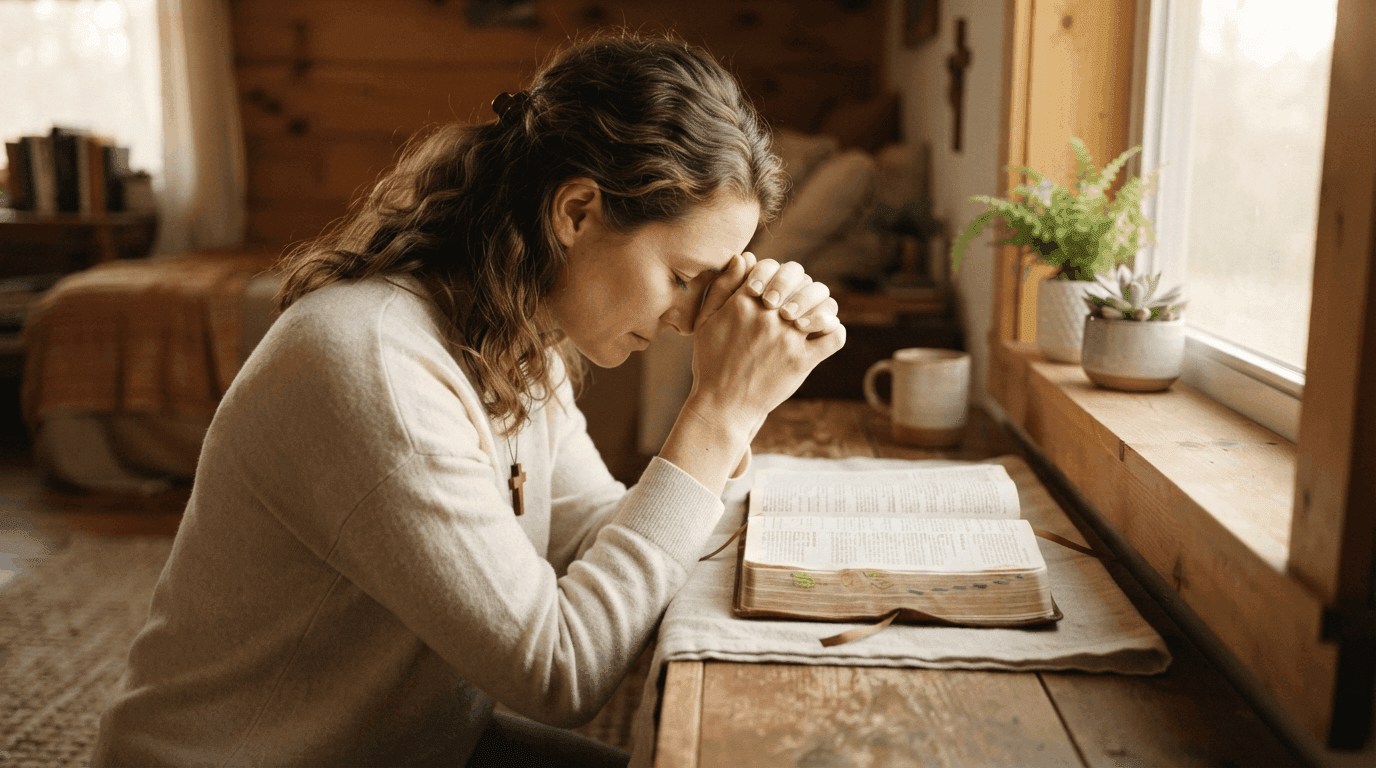
Trusting God in uncertainty means choosing faith over fear—not because the path is clear, but because God’s character is. Scripture consistently reveals a God who guides, sustains, and remains faithful even when our circumstances feel unstable. This devotional explores what that looks like in real, everyday life.
There’s a particular kind of stress that comes from not knowing what’s next. Maybe you’re waiting on a medical result. Maybe a job ended unexpectedly, a relationship fell apart, or a decision you’ve been wrestling with still has no clear answer. The plans you made quietly unraveled, and now you’re standing somewhere you didn’t expect to be—without a map.
This isn’t just a practical problem. For many Christians, uncertainty can quietly become a spiritual one. When life feels unclear, it’s easy to wonder: Is God still in this? Does He see what I’m going through? Can I actually trust Him with this?
Those questions aren’t signs of weak faith. They’re signs of honest faith—the kind that shows up in the Psalms, in the writings of Paul, and in the life of nearly every biblical figure who walked closely with God. Uncertainty has always been part of the human experience. What Scripture offers isn’t immunity from it, but something better: a God who is trustworthy precisely when the way forward isn’t visible.
This devotional is for anyone sitting in that uncertainty right now—not with easy answers, but with biblical truth, genuine encouragement, and a few practical ways to keep walking forward.
The Scripture at the Heart of This Devotional
Three passages speak directly to the experience of not knowing what comes next.
Proverbs 3:5–6 is perhaps the most well-known: “Trust in the Lord with all your heart and lean not on your own understanding; in all your ways submit to him, and he will make your paths straight.”
Written as part of a longer collection of wisdom literature, this passage was addressed to young people learning how to live well before God. The Hebrew word for “trust” here (batach) carries the sense of bold reliance—not a passive hope, but an active leaning. The instruction isn’t to stop thinking or planning. It’s to stop treating your own understanding as the final authority. The promise that follows—that God will make paths straight—refers to guidance and direction in life, not a guarantee that every outcome will be easy or painless.
Psalm 46:10 offers a different angle: “Be still, and know that I am God.” This verse comes in the context of upheaval—nations in chaos, the earth giving way. The stillness God calls His people to isn’t passive resignation. It’s a deliberate act of anchoring yourself in who God is, even when everything around you feels like it’s shifting.
Isaiah 41:10 speaks God’s direct comfort: “So do not fear, for I am with you; do not be dismayed, for I am your God. I will strengthen you and help you; I will uphold you with my righteous right hand.” Originally spoken to Israel in a specific historical context, this verse reveals something consistent and enduring about God’s character—His nearness to those who belong to Him, His willingness to strengthen and uphold. While not every specific promise given to Israel transfers directly to all believers in all situations, this verse expresses a truth about God’s nature that runs throughout the New Testament as well (see Romans 8:38–39, Matthew 28:20).
Together, these passages paint a consistent picture: God does not ask us to pretend uncertainty isn’t real. He asks us to trust the One who holds it.
What God May Be Teaching Us in Seasons of Uncertainty
Uncertainty has a way of revealing where we’ve quietly placed our confidence. When the future is clear and plans are working, it’s easy to mistake competence for faith. When clarity disappears, what’s left is what we actually believe about God.
This is why seasons of not-knowing can be spiritually formative in ways that comfortable seasons rarely are. They surface real questions. They reveal real fears. And they create space for a deeper, more honest dependence on God.
What these passages reveal about God’s character is worth sitting with: He is trustworthy. Not trustworthy because He always does what we hope He will, but trustworthy because He is unchanging, all-knowing, and genuinely good. He sees the whole story when we can only see the current chapter. He isn’t confused by your circumstances, and He isn’t indifferent to them.
There’s also something worth noticing in how Scripture repeatedly pairs God’s call to trust with reassurance of His presence. The command isn’t “figure it out” or “stay positive.” It’s “I am with you.” That nearness—Emmanuel, God with us—is the foundation on which trust is built.
What Does Trusting God Actually Look Like in Everyday Life?
Trusting God in uncertainty is less of a feeling and more of a practice. Here are five practical ways to live this out:
1. Bring your uncertainty honestly to God in prayer. Psalm 62:8 says to “pour out your hearts to him, for God is our refuge.” You don’t have to dress up your prayers or pretend to have more faith than you feel. Tell God exactly what’s weighing on you. Honest prayer is an act of trust.
2. Identify what you do know. When everything feels uncertain, anchor yourself in what hasn’t changed: God’s character, His past faithfulness, the truth of His Word. Keeping a short list of things you know to be true can be a practical way to steady your thinking when anxiety rises.
3. Take the next faithful step—not the whole staircase. You don’t need to know the full plan. You need to know what obedience looks like today. Ask: What is the right, loving, faithful thing to do right now? Then do that. Trust often moves forward one small step at a time.
4. Stay connected to the body of Christ. Uncertainty becomes heavier when carried alone. Share what you’re going through with a trusted friend, a small group, or a pastor. God often speaks and sustains us through other people.
5. Limit anxious speculation. There’s a difference between wise planning and spinning out on worst-case scenarios. When you notice your thoughts looping back to fear, that’s often a signal to stop and pray rather than to keep thinking harder.
When Trusting God Feels Genuinely Difficult
It would be dishonest to write a devotional about trusting God without acknowledging how hard it can be.
Sometimes the uncertainty is serious—a health crisis, a prodigal child, a marriage that’s fracturing, a grief that won’t lift. In those situations, encouragements like “just trust God” can feel hollow, even painful. And some of us carry wounds from seasons where we trusted and things still fell apart in ways that hurt deeply.
Scripture doesn’t minimize that. Psalm 13 opens with “How long, Lord? Will you forget me forever?” Habakkuk wrestled with God’s silence. Job demanded an audience with God out of genuine anguish. Lament is biblical. Honest struggle is not the opposite of faith.
What Scripture does offer—carefully, without making promises it doesn’t make—is this: God is present in suffering (Psalm 34:18). He uses difficulty in the lives of those who love Him, even when we can’t see how (Romans 8:28, which speaks specifically of those “called according to his purpose”). And He is patient with the doubts and fears of those who come to Him.
You don’t have to feel at peace to choose to trust. Sometimes trust looks like saying, “I don’t understand this, and I’m struggling—but I’m still turning to You.” That’s enough.
A Moment of Reflection
Take a few quiet minutes with these questions. You might journal your answers, bring them to prayer, or simply sit with them.
- What uncertainty am I carrying right now that I haven’t fully handed over to God? What would it look like to actually release it—not to pretend it doesn’t matter, but to place it in His hands?
- Where have I seen God’s faithfulness in my past? How does that history shape what I choose to believe about Him today?
- What is the next faithful step in front of me—however small? What would it look like to take that step today, even without knowing what comes after?
A Prayer for Today
Lord, I’ll be honest—I don’t know what comes next. And if I’m truthful, that unsettles me more than I’d like to admit. I’ve been leaning on my own understanding, trying to think my way through things that are simply beyond my view.
Help me to trust You—not just as a concept, but really. Help me to release the grip I’ve been keeping on outcomes I can’t control. Remind me that You see what I can’t see, and that Your ways are higher than mine.
Where I’m afraid, bring peace. Where I’m discouraged, bring hope. Where I’ve been walking this alone, remind me that You are with me. And help me take the next faithful step, even when I can’t see the one after it.
I trust You, Lord—not because the way is clear, but because You are good. Amen.
Today’s Takeaway
Trusting God in uncertainty doesn’t mean having no questions. It means choosing, again and again, to bring your questions to Someone who is actually trustworthy. You don’t need to see the whole road. You need to know the One who does.
Today, take one small step of trust: name what you’re carrying, pray honestly, and do the next faithful thing in front of you.
Frequently Asked Questions About Trusting God in Uncertainty
What does it mean to trust God when you don’t know what the future holds?
Trusting God in uncertainty means choosing to rely on His character—His goodness, faithfulness, and knowledge—rather than on your own ability to control or predict outcomes. Proverbs 3:5–6 describes this as leaning on God rather than your own understanding. Practically, it looks like honest prayer, staying grounded in Scripture, taking faithful steps forward, and resisting the pull toward anxious speculation.
Does the Bible promise that everything will work out the way I hope?
Not exactly. Romans 8:28 says that God works all things together for the good of those who love Him and are called according to His purpose. This is a real and meaningful promise, but it’s about God’s ultimate purposes—not a guarantee that every outcome will be what we want or expect. The Bible is honest about suffering, disappointment, and loss. What it consistently promises is God’s presence and His redemptive work, even in hard circumstances.
Is it okay to feel afraid or uncertain as a Christian?
Yes. Fear and uncertainty are part of the human experience, and Scripture is full of people who felt both—including David, Elijah, Paul, and Jesus Himself in the Garden of Gethsemane. Feeling afraid doesn’t mean your faith is failing. God’s repeated command to “fear not” throughout Scripture implies that fear is something His people genuinely experience. The encouragement is to bring that fear to God rather than be ruled by it.
How can I grow in trusting God when past disappointments have made it difficult?
Slowly, and with honesty. If past pain has made trust feel risky, that’s worth acknowledging—to yourself and to God. Start by returning to what you know about God’s character from Scripture, rather than building trust primarily on your circumstances. Lament psalms like Psalm 13 or Psalm 22 can be helpful models for bringing honest grief and difficulty to God. Trusting again after being hurt is a process, not a one-time decision.
What’s the difference between trusting God and being passive about my situation?
Trusting God doesn’t mean doing nothing. Biblical trust is active—it involves prayer, wise planning, seeking counsel, and taking faithful steps forward. The key difference is in where you place your confidence. Trusting God means acting faithfully while releasing the outcomes to Him, rather than trying to control everything through your own effort or obsessive worry.