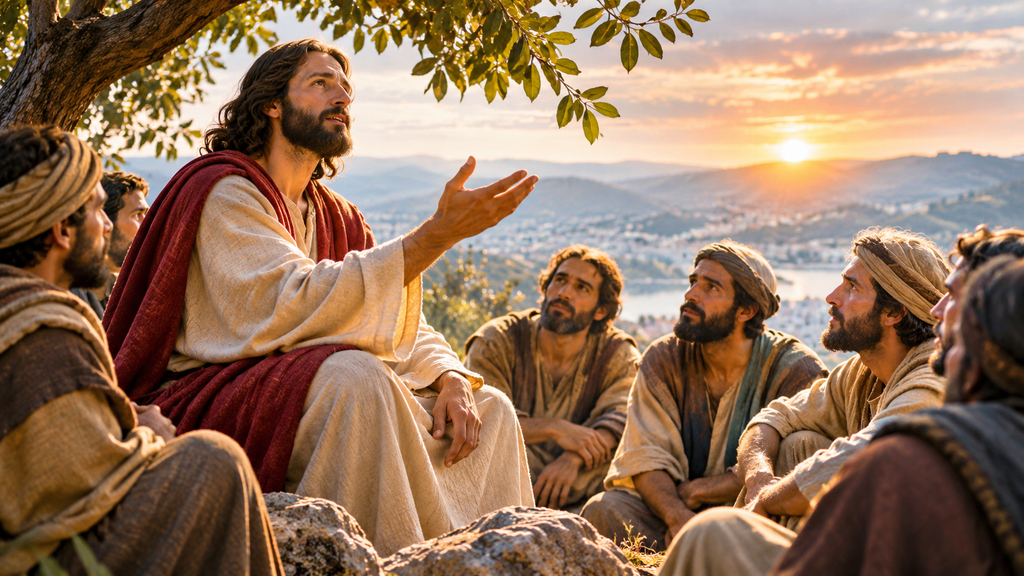
The Our Father who art in heaven Christian prayer is one of the most familiar prayers taught by Jesus Christ. Recorded in Matthew 6:9–13, it offers a meaningful pattern for worship, forgiveness, daily needs, and trust in God.
Many Christians have prayed the Lord’s Prayer hundreds of times, perhaps far more than they could count. And yet, if you’re honest, there are mornings when you reach “Amen” and realize the words flew by without a single thought attached to them. The familiar rhythm took over, and your mind went somewhere else entirely.
The Our Father who art in heaven prayer is more than a familiar set of words. It is the prayer Jesus taught His disciples, offering a pattern for worship, daily dependence on God, forgiveness, and spiritual guidance.
You’re not alone in that, and there’s no shame in it. “Our Father, who art in heaven” is one of the most widely recognized opening lines in all of Christian prayer. But familiarity can be the enemy of depth. Slowing down with this prayer pays back more than most people expect. Here at Christian Prayer Daily, we work every day to give believers tools that turn prayer from routine into relationship, and this prayer sits at the center of everything we do.
This article walks you through where the prayer comes from, how it reads across major Bible translations, what each petition actually means, how different Christian traditions use it, and how to make it a living part of your daily devotional rhythm. Whether you’re praying it for the first time or the ten-thousandth, there’s more here than you’ve found yet.
Where “Our Father Who Art in Heaven” Comes From
Jesus’ original teaching in Matthew and Luke
The Lord’s Prayer appears in two distinct settings in the New Testament. In Matthew 6:9–13, Jesus teaches it within the Sermon on the Mount, right in the middle of a section correcting showy, performative religion. His instruction is “Pray then like this,” presenting the prayer as a pattern for authentic devotion rather than a script to repeat mechanically. In Luke 11:1–4, a disciple watches Jesus praying and then makes a simple, hungry request: “Lord, teach us to pray, as John taught his disciples.” Jesus responds with a shorter version of the prayer. Matthew frames it as instruction on righteousness; Luke frames it as the answer to a disciple who desperately wanted to learn.
The Jewish world that shaped the prayer
Every line of the Lord’s Prayer sits naturally within the soil of first-century Jewish prayer. The themes of God’s holiness, his coming reign, daily provision, forgiveness, and deliverance from evil all have deep roots in Jewish scripture and communal worship. The communal “our” in “Our Father” is not an accident. Jesus designed this as a shared prayer for a community of disciples, not a private spiritual transaction. When you pray it, you are joining a voice that has always been plural.
How the early church made it their own
The Didache, an early Christian teaching manual from the late first century, instructs believers in Didache 8:2, 3 to pray the Lord’s Prayer three times daily. That single instruction tells you everything about how quickly this prayer moved from a teaching moment to the heartbeat of Christian worship. The familiar doxology, “For yours is the kingdom, and the power, and the glory”, entered liturgical practice during this period as well, though it is absent from the earliest and best-attested manuscripts of Matthew (including Codex Sinaiticus and Codex Vaticanus) and is generally placed in a footnote by modern critical translations. It is ancient; it is simply not part of the original text of the Gospel.
The complete text: traditional and modern translations side by side
The King James Version and why it still resonates
The KJV of Matthew 6:9–13 reads: “Our Father which art in heaven, Hallowed be thy name. Thy kingdom come. Thy will be done in earth, as it is in heaven. Give us this day our daily bread. And forgive us our debts, as we forgive our debtors. And lead us not into temptation, but deliver us from evil: For thine is the kingdom, and the power, and the glory, for ever. Amen.” For many believers, the archaic “art,” “thy,” and “thine” carry a sacred weight that modern translations simply don’t replicate. Notice that KJV Matthew uses “which art” and “debts,” though many congregations grew up saying “who art” and “trespasses”, wordings that entered wide practice through liturgical tradition rather than direct translations of Matthew’s Greek.
NIV, ESV, and NRSV: what changed and what stayed the same
The three major modern translations share the same essential structure but differ in three meaningful ways. First, the bread petition uses “today” in the NIV versus “this day” in the ESV and NRSV, a purely stylistic difference. Second, the NRSV renders the temptation petition as “do not bring us to the time of trial,” making the sense of testing more explicit than the familiar “lead us not into temptation.” Third, the NIV and NRSV say, “deliver us from the evil one,” while the ESV reads “deliver us from evil,” reflecting a genuine ambiguity in the underlying Greek (Matthew 6:9–13). All three place the traditional doxology in a footnote, since it is absent from the earliest and best-attested manuscripts of Matthew.
“Debts,” “trespasses,” or “sins”: understanding the difference
This is one of the most common points of confusion in Christian communities, especially when congregations from different traditions join together to pray. Matthew’s Greek uses the language of debts; Luke’s version uses sins. The familiar “trespasses” wording entered widespread use through William Tyndale and the Book of Common Prayer, not through a direct translation of Matthew’s text. None of these three renderings is theologically wrong. They are all pointing at the same reality: sin creates an obligation before God that only mercy can cancel. The word you use tells you more about your tradition than about which translation is more correct.
What each petition means for your faith
“Our Father in heaven, hallowed be your name”
The address itself is a theological statement before a single petition begins. “Our Father” holds intimacy and transcendence together: God is close enough to call Father, yet “in heaven” marks his divine authority and holiness. “Hallowed be your name” is not a polite opener. The Greek form is an imperative. It means: “May your name be sanctified, recognized as holy, honored as supremely worthy throughout the world.” It is a request that God’s character and reputation be vindicated in human lives and history. And it shapes the posture of the one praying: you cannot sincerely ask that God’s name be honored while living in a way that dishonors it.
Trusting God as our Father is central to a meaningful prayer life. Explore these Bible verses about faith and trust to reflect on what it means to depend on Him.
“Your kingdom come, your will be done”
These two petitions belong together because they answer the same question from two angles. The kingdom is God’s reign; the will is what that reign looks like in practice. Asking for God’s kingdom to come is both a present-tense prayer for justice and mercy to break into ordinary life right now, and a future-
facing hope for the final renewal of creation. “On earth as it is in heaven” pictures heaven as the sphere where God’s will is already perfectly enacted, and it asks for that same obedience to take shape in the ordinary human world where you actually live.
“Give us today our daily bread”
The bread petition is deliberately modest: not wealth, not surplus, but sufficient provision for today. It echoes Israel’s dependence on manna in the wilderness and teaches trust overanxious accumulation. The Greek word translated “daily” is the rare term epiousios, which can mean “necessary for existence” or “for the coming day,” suggesting a request for exactly what you need, nothing more and nothing less.
When we need reassurance that God is present in our daily struggles, Psalm 121:1–2 and its message of trusting God for help offer a meaningful reminder.
“Forgive us our debts, as we forgive our debtors”
The forgiveness petition works on two levels at once: it asks for God’s mercy while simultaneously committing the one praying to extend that mercy outward. Receiving forgiveness and withholding it from others are incompatible postures, and Matthew makes that unmistakably clear in the verses that immediately follow the prayer. This is not a transaction, it is a shape that a forgiven life takes.
“Lead us not into temptation, but deliver us from evil”
This petition is a confession of human vulnerability, not a suggestion that God tempts people to sin. It asks God not to abandon believers when trials press hard against their faith. “Deliver us from evil” widens the request: rescue us from everything that opposes God, whether sin, spiritual deception, or suffering.
The Greek can point to a personal spiritual adversary, “the evil one”, or to evil in general. Both readings are theologically consistent, and most scholars see them as complementary rather than competing. Either way, the petition is an act of surrender: Lord, I cannot do this alone.
How major Christian traditions use the Lord’s Prayer in worship
Catholic and Anglican liturgical use
In the Catholic Mass, the Our Father is prayed just before the rite of peace and Communion, directly connecting the themes of daily bread and forgiveness to the Eucharist. The congregation ends at “deliver us from evil,” the priest continues with the embolism (a brief prayer expanding the final petition), and then the congregation responds with the doxology. Anglican worship embeds the prayer throughout the Book of Common Prayer, from Morning Prayer to Baptism to the Eucharist, and most Anglican rites include the doxology. Both traditions typically use “trespasses” in their English wording, reflecting the deep influence of liturgical history over textual translation.
Protestant practice across denominations
Protestant use covers a wide range. Lutheran, Reformed, and Methodist churches recite the prayer corporately in Sunday worship, often near the end of the prayers of the people or before Communion. Reformed and Presbyterian congregations frequently use “debts” to stay close to Matthew’s language. Evangelical, Baptist, and Pentecostal churches may give the prayer less formal liturgical prominence, but they emphasize it in sermon series, discipleship classes, and personal devotion. Most Protestant traditions include the doxology, a practice inherited from the Byzantine manuscript tradition and the Textus Receptus rather than the earliest Greek manuscripts. Across all these differences, every tradition treats the prayer as both a model and a shared confession of dependence on God.
Turning the Our Father into a living daily practice
Praying each petition slowly as its own conversation
The simplest practical shift you can make is to pause at each petition and pray it in your own words before moving to the next line. After “hallowed be your name,” spend a moment naming specific ways you want to honor God that day. After “forgive us our debts,” name the person you need to extend forgiveness toward. After “give us this day our daily bread,” name the actual need you’re trusting God with right now.
This transforms the Lord’s Prayer from a recitation into a genuine conversation. It doesn’t take long, but it can change how you carry that prayer with you through the rest of the day.
Using the prayer in family and small group settings
For families, praying the Our Father together at meals or bedtime creates a shared rhythm that children absorb over years without realizing it. The words become part of how they understand God. For small groups, one productive approach is to assign one petition per week as a devotional focus: read the clause, study its background, discuss what it asks of your group specifically, and pray it together in your own words. This approach gives a group seven weeks of rich material drawn entirely from a prayer they may have been reciting their whole lives without mining its depth.
Resources from Christian Prayer Daily to help you go deeper
Christian Prayer Daily offers a growing collection of resources built around the Lord’s Prayer and the broader practice of structured Christian devotion. You’ll find the full text of the prayer in multiple translations, topical Bible verses linked to each petition, such as Matthew 6:33 alongside “your kingdom come,” or Psalm 23 alongside “our daily bread”, devotional reflections for each clause, and discussion questions suited for personal journaling or small group conversations. Whether you are discovering the Our Father prayer for the first time or returning to it after years of familiar recitation, these resources offer a meaningful starting point for deeper reflection.
The prayer that forms the one who prays it
Those familiar words, “Our Father, who art in heaven”, carry more weight than any single reading can exhaust. The prayer Jesus taught is not a warm-up routine before the real praying begins. It is itself the shape of a Christian life: worship placed ahead of self-interest, trust chosen over anxiety, forgiveness extended before retaliation, surrender offered before ambition. Every time you pray it with intention, you are being formed by it, not just reciting it.
If today is the first time you’ve paused long enough to think about what each line actually means, let that be the thing that changes how you pray it tomorrow. Christian prayer doesn’t need to be complicated.
Sometimes it starts exactly where Jesus started: with a Father who is holy, a kingdom that is coming, bread for today, and mercy enough for all of it.