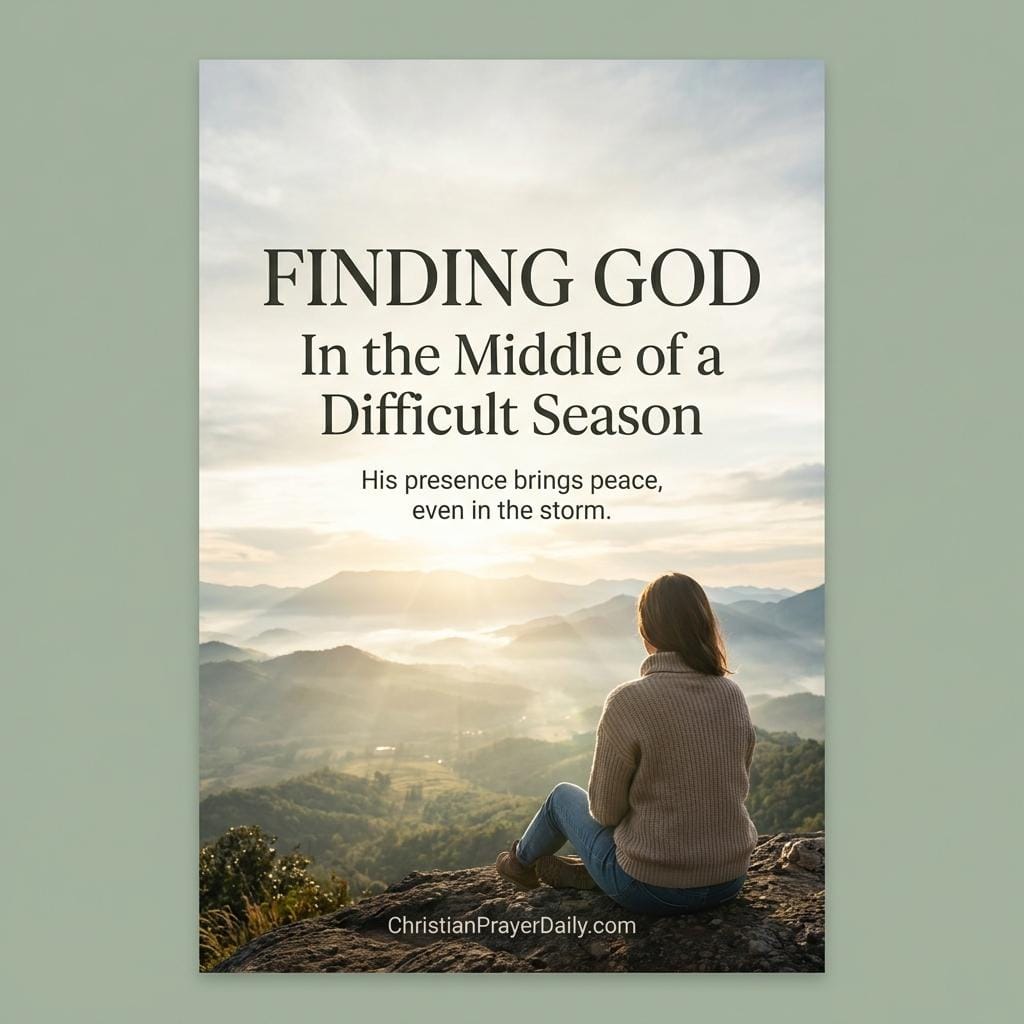
Finding God in difficult times begins with honest prayer, Scripture-rooted trust, and the recognition that God’s presence doesn’t depend on how a season feels. The Bible consistently shows that God is near the brokenhearted, active in suffering, and faithful even when circumstances suggest otherwise.
Some seasons arrive without warning. A diagnosis. A relationship that quietly unravels. A job that disappears. A grief that settles in and refuses to leave. And somewhere in the middle of it all, a question surfaces, one most Christians feel but few say out loud: Where is God right now?
That question isn’t a sign of weak faith. It’s one of the most honest things a person can bring to God. The Psalms are filled with it. The prophets wrestled with it. Even Jesus, quoting Psalm 22 from the cross, cried out, “My God, my God, why have you forsaken me?” (Matthew 27:46). If anything, the willingness to ask the question honestly is itself a form of seeking and Scripture has much to say about what God does when His people seek Him in the dark.
This devotional is written for anyone moving through a hard season right now, one that feels spiritually dry, emotionally heavy, or just plain confusing. It won’t offer quick fixes or neat theological bows. Instead, it’s an invitation to look carefully at what the Bible actually teaches about God’s presence in suffering, and to find perhaps slowly, perhaps imperfectly that He has not gone anywhere.
The Scripture at the Heart of This Devotional
Three passages anchor this devotional, each approaching the reality of God’s presence in difficulty from a different angle.
Psalm 34:18 — “The Lord is close to the brokenhearted”
“The Lord is close to the brokenhearted and saves those who are crushed in spirit.” (Psalm 34:18, NIV)
Written by David after a season of real danger—he had feigned madness before a foreign king to save his own life (1 Samuel 21), this psalm is a survival song. David wasn’t writing from a place of comfort. He was writing from experience. The assurance here isn’t that pain disappears but that God draws near to those in the middle of it. Proximity, not exemption, is the promise.
Romans 8:28 — Often Misread, Deeply True
“And we know that in all things God works for the good of those who love him, who have been called according to his purpose.” (Romans 8:28, NIV)
This verse is frequently quoted in ways that unintentionally minimize suffering. It doesn’t say all things are good. It says God works through all things including the painful, confusing, and unwanted toward a purpose. The original Greek word for “works together” (synergei) carries the idea of cooperative action over time. This is a promise about God’s sovereign trajectory, not an explanation of why hard things happen.
Isaiah 43:2 — With You, Not From You
“When you pass through the waters, I will be with you; and when you pass through the rivers, they will not sweep over you.” (Isaiah 43:2, NIV)
Spoken originally to the nation of Israel in exile, this verse reveals something profound about God’s character: He speaks of passing through difficulty, not around it. The promise isn’t that the waters won’t come. It’s that He will be present when they do. While this passage was addressed specifically to Israel in a historical context, the character of God it reveals faithful, present, sustaining is consistent with what the whole of Scripture teaches about how He relates to His people.
What God May Be Teaching Us in Hard Seasons
Hard seasons have a way of stripping away the things we lean on without realizing its busyness, routine, the comfort of feeling spiritually “on track.” When those things fall away, what remains is often a raw, unfiltered need for God Himself.
This is one of the most consistent patterns in Scripture: difficulty creates the conditions for deeper dependence. Not because God engineers suffering for its own sake, but because the human heart tends to reach most earnestly when it has nothing else to hold. The prophet Hosea described God as the One who leads His people into the wilderness to speak tenderly to them (Hosea 2:14). The wilderness, in other words, isn’t abandonment, it’s often the place where God’s voice is most clearly heard.
What hard seasons can teach, if we let them, is the difference between faith built on favorable circumstances and faith built on the character of God. One is fragile. The other holds.
Living This Truth in Everyday Life
Knowing God is present in difficulty is one thing. Experiencing that presence is another. Here are five practical ways to pursue God when a hard season makes faith feel like effort:
1. Pray honestly, not perfectly. There’s no version of prayer that disqualifies you from God’s attention. Lament psalms—Psalm 13, 22, 88 model a kind of raw, unfiltered conversation with God that the church doesn’t always encourage. You don’t have to package your pain neatly before bringing it to Him.
2. Stay in Scripture, even when it doesn’t feel productive. Feelings of spiritual dryness don’t mean the Word stops working. Read slowly. Read a single verse. Read the Psalms when systematic study feels beyond reach. The goal isn’t to feel something immediately, it’s to keep returning to the source of truth when emotions are unreliable guides.
3. Reach out to a trusted Christian community. Galatians 6:2 instructs believers to “carry each other’s burdens.” This isn’t optional sentiment, it’s a structural part of how God designed the church to function. Isolation in hard seasons is rarely helpful, even when it feels instinctive.
4. Practice small acts of gratitude. Not toxic positivity. Not pretending the hard thing isn’t hard. But a deliberate, daily practice of naming what is still good, however small can slowly recalibrate the heart’s default setting. Psalm 103 begins with David calling his own soul to attention: “Bless the Lord, O my soul, and forget not all his benefits.”
5. Give yourself permission to move slowly. Healing and spiritual renewal rarely arrive on demand. Some seasons of difficulty last longer than we expect them to, and there’s no spiritual failure in that. Trusting God’s timing, even when it’s slower than you’d like, is itself a form of faith.
When Faith Feels Difficult
It would be dishonest to present this topic without acknowledging that some seasons genuinely shake a person’s faith. Doubt doesn’t make someone a bad Christian, it makes them human. The disciple Thomas doubted. John the Baptist, imprisoned and waiting for death, sent word to Jesus asking, “Are you the one who is to come, or should we expect someone else?” (Matthew 11:3). Jesus didn’t rebuke him. He answered him.
If you’re in a season where prayer feels hollow, church feels mechanical, and Scripture feels distant, you’re not spiritually disqualified. You may be exhausted. You may be grieving. You may simply need rest as much as revelation.
What Scripture consistently urges in these moments isn’t increased spiritual performance, it’s continued turning toward God, even imperfectly. The promise of Jeremiah 29:13 is quietly radical: “You will seek me and find me when you seek me with all your heart.” Not when you seek me perfectly. Not when you seek me without doubt. When you seek me with all your heart—including the broken, questioning, uncertain parts of it.
A Moment of Reflection
Take a few minutes to sit quietly with these questions. You might journal your thoughts, bring them to God in prayer, or simply let them settle in your mind.
- What does your honest prayer sound like right now? Not the version you think you should pray the version that’s actually true. What would you say to God if you weren’t trying to say the right thing?
- Where have you seen God’s faithfulness in past seasons of difficulty? Is there a moment however small, when He came through for you? What does remembering that do to your faith today?
- Is there something this season might be inviting you to release? Not to minimize what you’re carrying, but to consider whether there’s a weight, an expectation, a plan, a version of the future that you’ve been holding tightly, and what it might look like to loosen your grip.
A Prayer for Today
Lord, I’ll be honest with You, this season is hard. Some days I can’t feel You at all, and I don’t always know what to do with that. But I’m here. I’m still turning toward You, even when it feels like going through the motions.
Remind me that You are near not because circumstances say so, but because Your Word says so, and You are faithful. Help me trust Your character more than my feelings. Help me receive comfort from others when I need it, and offer comfort when I can.
I don’t need everything to make sense right now. I just need You. Meet me here, in the middle of this. Amen.
Today’s Takeaway
God’s presence in a hard season is rarely loud. Often it’s quiet a verse that lands differently than it did before, a friend who calls at the right moment, a morning where the weight feels slightly lighter. These aren’t coincidences. They’re the fingerprints of a God who promised to be close to the brokenhearted.
One thing to carry into today: Choose one honest thing to say to God before the day ends. Not a performance, just truth. That’s enough of a beginning.
Frequently Asked Questions
What does the Bible say about finding God in difficult times?
The Bible consistently teaches that God is present with His people in suffering, not absent from it. Psalm 34:18 says He is “close to the brokenhearted.” Romans 8:28 affirms that He works through difficult circumstances toward a good purpose. Isaiah 43:2 describes God as present with His people as they pass through hardship. These passages together paint a picture of a God who accompanies rather than exempts.
Is it normal to feel spiritually distant from God during a hard season?
Yes, and it’s well-documented in Scripture. Many biblical figures like David, Elijah, Jeremiah, and even John the Baptist experienced seasons of spiritual struggle, doubt, or emotional exhaustion. Feeling distant from God doesn’t necessarily mean God has moved. Grief, trauma, exhaustion, and depression can all affect how we perceive spiritual reality. Continuing to seek God honestly during these seasons, even imperfectly, is what Scripture commends.
How can I hear from God when I’m going through a difficult time?
God communicates most consistently through Scripture, prayer, and community. During hard seasons, it’s worth simplifying your approach: read a single psalm slowly rather than attempting long Bible plans, pray honestly rather than formally, and stay connected to at least one or two trusted Christians who can speak truth into your life. God doesn’t require perfect spiritual conditions to reach you.
Does God cause difficult seasons, or does He allow them?
This is a question theologians have wrestled with for centuries, and the Bible holds both truths in tension. Scripture shows that God is sovereign over all things (Proverbs 16:33) while also making clear that suffering often has multiple causes including human choice, a fallen world, and spiritual opposition. What the Bible is most consistent about is not why hard things happen, but who is present when they do—and what God’s ultimate purpose is.
How long does a difficult season last, and when does it end?
Scripture doesn’t offer a formula for the duration of difficult seasons. Some, like Job’s suffering, resolve relatively quickly in narrative terms but feel endless from the inside. Others, like Paul’s “thorn in the flesh” (2 Corinthians 12:7–9), are never removed but become the context for encountering God’s grace more deeply. The honest biblical answer is that seasons differ, God’s timing isn’t always our timing, and the goal is not speed but faithfulness through the process.